
How TransferWise drives growth
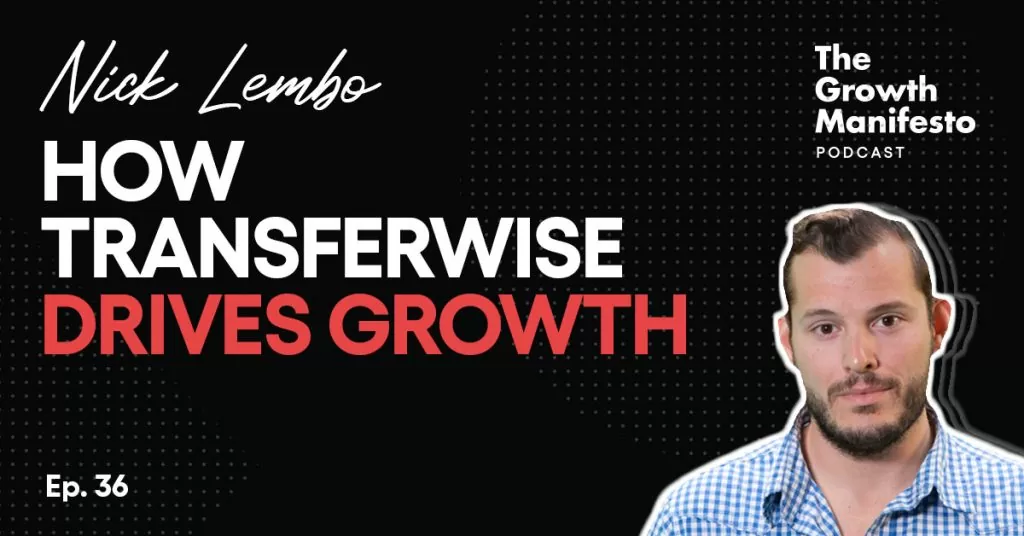
Nick Lembo, who heads growth for TransferWise in the Americas, explains how customer demand data, not big datasets, drives expansion.
 with Nick Lembo


Overview
This episode is a discussion with Nick Lembo – who headed up growth for Transferwise across APAC, and now heads up growth for Transferwise in the Americas. We talk about how Transferwise drives growth across different regions, how its mission drives everything they do, how they use data to drive decisions, and everything in between.
Key takeaways
- TransferWise decides which country to launch next by tracking a currency wish list of customer sign-ups rather than broad World Bank or OECD remittance data.
- About 60% of TransferWise's growth still comes from word of mouth, so the company prioritises NPS drivers like price, speed and convenience.
- Localising a new market means integrating with local systems, like Singapore's government ID database and faster payment network, not just translating text.
- TransferWise runs about 70 autonomous teams, each acting like a startup within the company so the person closest to a problem can solve it.
- Employees regularly do side-by-side shifts answering customer support queries directly, because talking to a customer reveals more than any usage data can.
Chapters
About the guest
Transcript
Auto-generated from the episode audio, so expect the odd mis-heard word. Timestamps open the video at that point.
The way that we always think about regional expansion is focusing on where do customers want to use us, first of all. So there's tons of data out there around remittances and where money flows. And you can look at big, heavy data sets from the World Bank or from these types of bank international organizations, OECD, where's money flowing and all this and that. But what we actually found to be the most accurate predictor of our growth when considering should we launch
country X or country Y in a new part of the world was basically listening to our customers. You're listening to the Growth Manifesto podcast, a Zoom video series brought to you by Web Profits, a digital growth consultancy that helps global and national businesses attract, acquire, and retain customers through digital marketing. This episode is a discussion with Nick Lambeau, who headed up growth for TransferWise across the Asia-Pacific region and now heads up growth for TransferWise in the Americas. We talk about how TransferWise drives growth across different
regions, how its mission drives everything they do, how they use data to drive decisions and everything in between. So let's get into it. So today we're talking with Nick Lembo who leads TransferWise's success or growth as they call it within the Americas. He's worked in both the B2C and B2B spaces for global tech companies, covering the country management, plus expansion, the marketing and communications, plus the most important thing is growth. Sorry, I am very towards the growth industry. He's also a guest
lecturer in RMIT. That's in Melbourne. And he's also had his own healthcare startup. Although now you live in New York, is that right? I'm now based in New York, yes, Alex. And when did you go to New York? How long ago was that? I left Melbourne in December 2019 and got to New York just at the tail end of the year and have been here for all of 2020. So it's been an interesting experience, needless to say. Wow, that's timing. And you've gone from Melbourne to New York.
So they're both very challenging places, I guess, within this pandemic. So, yeah, it's, I don't know which is the better place, but I think you're there now. So that must be the better place. Yeah, it's been okay. You know, you find the silver lining as you can and whatever has been possible this year, I suppose. Yeah. Okay. Well, let's get straight into the growth side of things and the marketing side of things. So just high level on TransferWise, because I know that, because I've been a customer
of TransferWise for a number of years now, actually, and it's pretty good. But for the people who don't know, what does TransferWise do? Sure. So TransferWise is a financial tech company that lets people manage and move their money from between currencies, basically. So we started in 2011 when our co-founders, Tavit and Christo, had a problem. They were sending money from one country to another and realizing that doing so through their banks was costing them quite a lot through an inflated exchange rate.
So Tavit was based in London, but being paid in euros because he was Skype's first employee and was remote from their office in Estonia. And Christo was based in London and paid in pounds, but also originally Estonian and had a property in Estonia. So rather than sending money back and forth from pounds to euros with their banks, they realized that they could look up the mid-market kind of real exchange rate on Google and simply conduct two domestic transfers of the corresponding amount out of either their pound account or their euro account.
And very quickly realized that this is a real problem that lots of other people probably face. and nine years later we now have a suite of products not just our money transfer product but a suite of products that help people move manage spend and send their money all around the world for less money than incumbents for a faster way to do that and more convenient you know we're a digital first business so today we have about eight million customers we're moving
5 billion US dollars equivalent to every month for those customers all around the world to 70 something countries around the world. Yeah. Wow. Yeah. And so started about, well, started almost 10 years ago now shortly, and it's a fintech company and, and it's trying to disrupt, well, it is disrupting the banking industry. And I know that you've recently, I think it's recently you launched the stop the exchange ripoff report. Is that been launched just recently where it talks about how banks actually but they make a cut
in terms of their fees from the margin that's right so one of the biggest problems uh that we solve for people is the cost of sending money abroad is really not transparent um through most kind of incumbent providers whether using a bank or a paypal or a western union um and that's because those providers include a pretty hefty markup on the exchange rate. So they might tell you that you're paying $10 to send your money from Australia to the US. But in practice, there's a 5%
markup on the exchange rate as well. So the total cost is actually really difficult to work out. And that's, if you even know in the first place that that thing is happening, right? So most people are vastly unaware that there's this hidden fee, as we call it, baked into the overall total cost of the transaction. So one of the things we do in most markets around the world where we operate is try and bring some transparency to the sector and help our customers also understand the problem
that we're helping them solve. It's not just around the speed of the transfer and the ease of the transfer, but the price in the way we price with a clear upfront fee, the mid-market exchange rate, how it's different to competition of these traditional providers like I talked about. So that report you referenced is the latest version of that kind of transparency push that we've done here in the US, but it's also something that we've done all around the world in the UK, in the Eurozone, Australia, Singapore. And it's really trying to solve that problem of, are people even aware of how
much they're really spending to send their money around the world if they use an incumbent provider. Yeah, sure. Because I mean, this is a long time ago now, but I remember the exchange rates at the money exchange at the airports and have the rates, right? And all the rates would be different, right? And that's back when you could see the rates. Now you don't see the rates anymore. It's really easy to just to send money and they tell you a rate at the time, but you don't really You have a comparison. You don't know how that actually compares to the bank rates or to the other, the core exchange rates.
And so it can get complicated, right? Absolutely. Trying to get this message out. Even when you show people in a mocked up hypothetical example, let's say, of provider A shows their price this way and provider B shows their price this way, which one is the total cost of a better deal? it sounds so simple to do a little bit of arithmetic, right? And to do a bit of math, but it's actually really hard to do it on the fly, especially if you're not used to trying to calculate, you know, a certain number of basis points on top of an exchange rate. So
I personally have actually had this problem, you know, you can tell by my American accent that I grew up in the States. But I think as we talked about before, you know, I spent the past 10 years living in Australia and anyone who knows anything about the American education system knows that that most people come out of school with a lot of debt. And so I was living and working in Australia and paying off my student loans in America, sending money every month through Commonwealth Bank back to my student loans in the US to pay them off and realized after I talked to a friend who had a similar problem at the pub
that, hey, this is actually something that's costing me a lot more money and I didn't even really understand. And so I was a transferwise user in that kind of use case for a good year before I joined the company. So it's a problem. It's a big problem that most people don't even know they have. So in terms of transfer-wise a success, is it majority consumer or is it majority business to business in terms of the transfers, the volume of transfers anyway? So the majority of our, let's say, cross-currency transfers are still with consumers today.
But increasingly, small and medium businesses is a really large part of our business. mostly because once a business understands that they have this problem, it's a regular recurring need every month, right? Whether they're paying payroll or a supplier or a freelancer, whereas you or I might send money abroad, you know, maybe a couple of times a year. Once that business realizes there's a better way to do it, they're coming back every month to use us for all of their kind of foreign exchange needs. And the ability to do that is really because over time we've built out the
product suite to be more than just sending money abroad. That's still one of our biggest products. But we've heard over time from our customers, you know, that they have these other problems that they would love for us to help them solve the same way we've solved this really simple experience, made this experience of sending money really simple and cheap and fast. And so, you know, over the past nine years, we've launched a business product. Like we've talked about, we've also launched what we call a borderless account, which is a multi-currency account that lets you have your own bank account details all around the world, regardless of where you are.
And increasingly, enterprise and like really large scale business solutions. So now even challenger banks and really large enterprise companies like Xero and QuickBooks and these types of accounting softwares are starting to integrate TransferWise natively into their apps and solutions so that their money flows over TransferWise and their customers get all the benefits of cheaper, faster, more convenient transfers without having to leave whatever that ecosystem or app might be as well. Yeah, sure. And I mean, because I started with TransferWise as a business customer, because I was just
looking for a way, because I was transferring specific amounts of money overseas every single month because we have staff across the world. And it's like the costs were changing so much and the exchange rate was such a big difference. And so that's when I found TransferWise. And it's super easy and it's super quick. So this is a fun conversation because I'm going to ask you actually how you got to me and how you kind of have expanded over the time. Because I know you joined the company about three years ago. Is that right? Before years in January. Four years in January. And so what were you hired to do at the time?
so i was one of the early hires in the asia pacific region um and was really brought in to grow and build our marketing and communications team across that region um so i was based in melbourne australia at that time we had a small very small office in sydney as well um and we had small office in Tokyo. And so over time, my role in Asia Pacific focused on how do we bring brands
to more customers in countries where we launch, for example? How do we tell that story? Obviously, PR and communications through the media and to all the people that want to need to know about us in that kind of sphere as well. And, you know, we went from operating in Australia and Japan, launching in Singapore and Malaysia and, you know, a number of other countries around the region. So grew that team, grew the functions, helped launch a bunch of new markets and bring TransferWise to new people in that part of the world,
which was super fun before relocating here to New York in end of 2019. Yeah, sure. So how many countries were you responsible for? At the end, it would have been more than a dozen. I can't remember the exact number. So there's some pretty quick regional expansion across Australia and New Zealand and then lots of countries in Southeast Asia and Japan and Hong Kong, India. Pretty rapid kind of rollout across the region was a big part of my time in that part of the world.
So did you have a strategy for how you rolled out to a specific country? And if so, can you talk about it? Yeah, sure. So I think it's important to step back and say the way that we always think about regional expansion is focusing on where do customers want to use us, first of all. So there's tons of data out there around remittances and where money flows. And you can look at big, heavy data sets from the World Bank or from these types of bank
international organizations, OECD, where's money flowing and all this and that. But what we actually found to be the most accurate predictor of our growth when considering should we launch country X or country Y in a new part of the world was basically listening to our customers. So if still just today, we call it a currency wish list. If you come on to the TransferWise website and you live in China, for example, and you can't send money out of China on TransferWise today,
you'll type in your currency or your country, you'll see a little message that says it's not available. And there's a little box pops up and says, leave your email address. And when we're in beta testing and ready to launch, we'll let you know. So you can be one of the first ones to use a product. Now it's a very imperfect proxy, especially compared to, like I said, these huge data sets. But we always found with a few exceptions, but for the most part that the countries where we had the most latent demand that we hadn't yet tapped into because we weren't launched there were places where we were going to have really strong product market fit.
We were going to be able to scale quickly and we knew people wanted to use us. So that's how we prioritize on a regional level, roll out, let's say, from one country ahead of another. So it's why we launched Singapore before we launched Hong Kong, for example, things like that. Is that because of the website, was it? Because people were coming to the website, they were trying to transfer and then they found that they couldn't transfer to a country because that's what I was finding at the very start. Yes, exactly. Because there were some countries I was like, oh, damn. can't send to that country yet, you know? Yeah. So if you want to send money to that country or
from that country, if it's unavailable, we'll pop up a little, we'll have a little module pop up and we'll say, Hey, this isn't available yet. Leave us your details and we'll let you know what it is. And just collecting that data, aggregating it and looking at the total kind of demand was really the best predictor of where we would see, you know, pretty quick adoption. And then when it comes to, let's say we've actually decided, we looked at that data, the next country we're ready to launch. I think one of the last launches I worked on before I left Asia Pacific was Malaysia. And
then really what we do is, you know, not dissimilar to how many other kind of growth or teams would operate in a expansion basis. You know, we put together a launch plan. We understand who our customers are, what use cases we're solving for those people that are the same as all of our customers around the rest of the world and what's different, you know, um, who do they want to send money to where are they planning to send money to, um, and, you know, create a multi-channel plan of how do we let people know about the product? Um, and that usually encapsulates all the normal
things like, um, our product marketing teams and, you know, all of our kind of performance marketing channels. Um, but also we make sure that we try to create some, some element of, you know, bringing, those early adopters in, having some type of event, getting to meet founders, creating a bit of that kind of community buzz as well is really usually part of how we roll out. Yeah. So just on that point, and correct me if I'm wrong, but you would decide which country to go to next based on the people that were coming to the website, trying to transfer funds to a specific
location. And that would be the data which kind of led the decisions, right? Yep. how did you get people coming to the website in the first instance? Cause I never heard of you guys. And then all of a sudden, somehow I heard of you guys. Right. And I don't know what that strategy was. And then all of a sudden we're transferring a lot of cash every month now, you know, between all these regions. Right. So, you know, that first part before you even had that traffic. Yeah. How did you go about that? Yeah. Because that second part is cool. Let's optimize based on data,
but like you needed to launch, you know, within Australia. Right. So how did you approach that? Yeah. So to go back to the first part of your question, it's a, it's a good insight into how we kind of grow globally around the world. Right. So people like yourself or someone sitting in Malaysia, who's hitting transferwise.com and can't use the product. Why are they going there in the first place? Like you said, so there's a couple of things that are happening. So one is just good old fashioned word of mouth. Um, something like 60% of our growth today still comes from word of mouth channels and
are kind of organic growth channels. So it's hard to validate that in a new market, but we know almost everywhere where we launch that percentage of word of mouth and kind of friends and family referral growth is the bulk of our growth. Um, and so we know that it holds true in terms of when we're seeing latent demand in a new country where we haven't yet launched. Most of that is going to be from word of mouth. The other half of it is, you know, I'm not an SEO person by background, but we have a really good SEO team that's done well to capture and understand search traffic and search terms all around the world.
So there's a very strong chance if you're hitting, if you're Googling send money from Malaysia, you're going to hit a transferized page, even if our service isn't yet live in that country. So combine those two things. And I think you account for how and why most people might end up in that place where you said for the first time that they're landing on a direct webpage with TransferWise, but we don't actually solve for their use case yet. Yeah, sure. It's interesting because just thinking around the SEO strategy, I mean, you've got keywords around every combination of currencies, right?
And then you've got all the variations of how somebody could search those currencies. And then you could see how much you would spend on Google Ads if you had to spend money on Google Ads to get that traffic. So SEO does sound like an awesome strategy. And are you able to talk about that strategy at all? Or is that very specifically with the SEO team? Pretty specifically with the SEO team. I mean, I can in broad strokes tell you that it centers around understanding what the search volumes and queries and terms are, of course. understanding the countries of course like we said um also understanding competitors is a big
part of this right um and then there's this other area around who are our customers in the first place and and creating content around that that's going to rank so things like we might not solve for but if you googled if you lived in australia and you googled how to open a bank account in the US, chances are you would probably land on a TransferWise page. That's more around if you Googled what are the best, what are taxes like in France as an expat? These types of like lifestyle things that we know fit our customer base are areas where we create lots of content series
around them so that they become scalable. And they're really talking to the type of person that typically would end up being a customer of ours, or at least they don't choose us. We're in the consideration mix, if you know what I mean. so yeah yeah i do so seems then that personas are really really important like to really understand who you're targeting um but how important are personas there at transfer wise so you know we use personas when we're going to a new country and thinking about trying to understand what's
different in the cultural landscape that we need to understand you know um i think it's super important and it's hard to overemphasize how important that can be when you know you're an American trying to launch a product in Malaysia you know there's you need to understand what's going on right but mostly what we focus on is capturing the data that would normally be put into a persona anyway and what I mean by that is so we might not say you know Alex the expat is a
persona of a person living in Australia, sending this much money for his business. But we might understand deeply that business customers who have between X and Y employees and are sending money from one currency to multiple currencies or a single currency will have all the data points that we consider around their use cases of their average. How much are they sending every month? What is important to them? Is it all about paying people who might be working for them on a freelance basis? Or is it also about receiving funds for things that they're selling through third-party platforms and things like that. So we're a pretty customer-led business and spend a lot of time
talking to customers, which is one of the things I like to do almost more than anything at TransferWise. So we utilize the same type of data that would go into a persona, but, you know, kind of down to different teams, if they choose to actually put that into the traditional, you know, persona framework that you would learn in business school or in a marketing bootcamp or whatever that might be. Yeah, sure. Okay. I got it. I got it. And so a lot of the decisions around the growth strategies are they're based on data right like that's the big thing i've heard like
so far is yeah the data the data the data the data the data so it does seem like that's kind of like a central component of actually how you drive growth is that right i mean i think any any good marketing or growth team would be uh optimizing for that right like if i think about our growth strategy more broadly i think you know it can really boil down to three pillars and each of those pillars is going to have their unique data points that they're looking at to optimize that. So one is, like I said, word of mouth and our kind of people telling friends and family.
We know that that is still even nine years later, which is kind of crazy, the majority of our growth today. And we see that kind of referral trend or virality kind of graph, whatever you want to call it in new markets unfold as well. But we only see it unfold if we know that NPS is going to be above a certain point. So we have a lot of data from country launches when we think about our organic growth that we know if NPS of the product in the early stages sits at this level, we're going to see a really strong word of mouth growth graph tracking that, right? So we focus a lot on how
we optimize word of mouth growth. That was one of my questions. Yeah. Which I want to hear about. Yeah. So happy to dive into that. That's definitely one pillar is optimizing word of mouth and organic channels and how people can talk about transfer wise to their friends and family and why. The other kind of second pillar is obviously paid. You know, we run a pretty strong multi-channel performance marketing team. I already talked about SEO, but, you know, paid social is a huge part of that strategy, as well as organic channels falling into this space.
You know, knowing where our customers are on the internet and trying to give them relevant information about TransferWise at the right point in their customer journey. And then the third part that I think about after kind of paid and organic growth really comes down to, like I said before, product. So what started as a money transfer business, like I said, I've already talked about this, but nine years ago, over time, we've heard from customers the addition of extra use cases and bringing that insight from listening to customers into product teams so that they know to launch a debit card and build this multi-currency account.
and that small and medium businesses are using us in this way. And actually they might have a totally different need around integrating with accounting softwares or adding multiple users to their accounts. So their business partners can be on there, you know, all these types of things. It's hard to over, over emphasize, you know, how much growth comes from listening to your customers and building what they need back into the product. And so the product led growth approach, right? Where you launch in a country, you get the NPS scores, the NPS scores aren't high, but it's the same exact product, let's say, that the other country
that is doing extremely well. How much changes per country to achieve the tipping point? Yeah. How much has to change? So we know when we think about NPS and how it relates to word of mouth growth, we know that for the vast majority of our customers, there's three things that move NPS in a meaningful way. Price, speed, and convenience of the product, right? And so we know really well
how to move price down. Doesn't mean it's always easy, but we know that if we're, you know, eight, nine, 10 times cheaper than the competition, you know, that delta is going to be enough that people are going to, price-led growth is, you know, we're the cheapest in the market. If we're not the cheapest in the market, the other two levers we can pull around speed and convenience are really important as well. So speed, you know, typically international payments, if you send them through a bank, three to five business days, right? Like something like 30% of transfer wise payments around the world are now instant because we prioritize building those integrations into faster payment systems and things, you know, we're prioritizing those things that let us speed up the payments on the product roadmap.
that. And then the last one of convenience is the murkiest. Price and speed are very obvious. Hey, make it cheaper and make it faster. It's not always easy to do, but customers tell you what they want. Convenience really comes down to understanding the customer, I think, in the local context a lot. So how is that person used to paying for things? If it's a market where people use debit cards and credit cards more than bank transfers like America, we need to prioritize building those methods for them to pay transfer-wise. If it's a market like Eurozone,
where, hey, actually sending a bank transfer to a company is a very normal financial behavior for people paying bills or whatever, let's prioritize building that. So it's a small example, but there's a lot of things that are not always obvious when you're new in a market that might make the product way more convenient for people and drive up the NPS along with price and speed, Like I said, so pay-in methods are a huge part of that around building convenience in the product for us. Yeah, cool. Thanks for sharing that. That's really helpful.
The other one about going to different countries is how did you approach the multilingual marketing thing? Because, you know, Singapore, you can advertise in English. Malaysia, not so much, right? I mean, you can, but is that how you did it? Like you just focus on English speakers or did you go completely multilingual? Yeah. So, you know, there's a good anecdote that localization is not translation, right? And localization of the product translation is definitely a big part of that, but it can mean so many more things.
Do you have the right colors? Are the right types of case studies you're showing on your pages, the things that will resonate with people? I mean, those are bad examples, but, you know. But they're simple to understand. The point stands, right? Yeah. Um, so the, all of that is to say, when we think about translation, um, we're not always fast in that space, but we really think deeply around what is the, not just the amount of people using us in whatever language today, but what is the total kind of addressable group size of people who want to use us in a new language.
So we have obvious data points that we can look at for things like that, like, um, language settings for people on our apps and things like that. mobile web as well. But when it comes to a rollout, like a brand new country, we're almost always in English first. And then I don't want to say plain catch up, but like working backwards from there, knowing that translation is a thing we're going to have to do. But, you know, we run lean product teams, lean growth teams, lean marketing teams, figuring out where the translation is, is the kind of next thing to do. But we always kind of
prioritize for speed to market and that means English always comes first so you know I'll give you an example um we just launched um traditional Chinese this quarter uh nine years right and that's a long time if you think about how big of a language group it is and how long we've also been present in markets like Hong Kong um uh so you know it is something that's always on a roadmap that, but it's not always the first thing we get out the door. Or when the time does come to translate, what's your process?
I am the worst. Or to localize, sorry, to localize, not translate, to localize. So I think localization in product teams comes down to a lot of those things that I'd talked through for convenience, right? Understanding what are the financial tools or the financial mental models that people use already in a given market and how could we or how should we integrate with those? So I'll give you a good example from Singapore. One of the first things that we did in Singapore was integrate with their equivalent of the faster payment system so that you can now send us money
instantly. That's an open API that we were able to integrate with. We did another thing in Singapore where they have, I forget the name of the system, but basically the government's database of citizens, you know? So if you want to, when you're signing up and you're verifying your account you can just send us your information. It makes an API call to the government's database and then you're verified. You no longer have to upload a photo of your passport and do those types of things. So those little things make a big difference in localization. And even on the product side, it's not just for people who use us.
earlier this year, you know, we integrated with the ability to pay out to Alipay users in China. So that is a localization, even though we're not available in China, you can send money to China, but not from China. So if you're a Chinese national living abroad or not even a Chinese national, but you have friends and family there, you can still pay them in the most convenient way. So that money just ends up in their Alipay wallet rather than in a bank account. And so the localization sits on both sides, whether you're paying the money and registering yourself
as a user or thinking about the recipient as well. Okay. Okay. That's interesting because it's that when people think about going into a new country, they just think first thing they think of probably is the language, right? They think, oh, well, it's that language. But what you're talking about is that they actually operate fundamentally or differently. There's other things which personally in Singapore, like that they would expect that they could do as part of the signup process. And if you're not connecting to the government's API, what the hell is that?
Of course, now I have to scan my documents and upload them. I can't do that. And that hurts your growth, right? Yeah, absolutely. Small little function. Small thing, small example, but a function that someone that just removes that friction to usage that would otherwise exist, right um there's also other things when we're thinking about um you know localization that are not just being translation for us um really comes down to you know transferized customer might be
unique in this context it's important to think about the product and who your user is right so coming back to personas and what we talked about before if i'm launching a gaming streaming service for people in Malaysia, or, you know, I'm probably, I'm going to, I am going to need local language support from day one, but our customers are, this is a bit of a generalization, but, you know, in most countries where we launch, about half of them are immigrants and expats. The other half are locals, right? So we know we're going to be able to serve those customers
in English from day one, and therefore translation can wait a little bit. That might not be the case depending on your product or your service, right? But for us, we know that about our customers. Like, hey, we can capture all of these early adopters in English and we can solve for the other half of our upcoming users when we have time and can build that into our kind of development roadmap. So you guys really understand your customers like at another level. And then you have all this other data that will support the shifting understanding across specific regions, right?
Because it seems like it's always changing. Is that right? Or is it always kind of the same? Is it always kind of the same? like people just going to send cash to their friends and family and they just need to find someone? So the answer to that question is a little bit of, a little bit of column A and a little bit of column B, right? Like it sounds, I mean, it's a bit of a, you know, a flippant response, but really like most people who are sending money around the world are doing it a couple of times a year to friends and family. That is the overriding use case. However, that long
tail of other use cases is still many millions of people and many billions of dollars moving around the world that they could save. So it's not just one or the other, but the vast majority of the amount of people might sit in this camp, but 10% of your users are sending tons of money because they're doing it for their business or they have a property abroad or they have kids studying abroad. They have something that's making them send money every month. So you have to manage that balance of uh who's sending how much in in other places you know yeah sure okay thanks for
that um just let's jump back to you do word of mouth optimization or is it nps score optimization or something like that like is that something that we just spoke about a second ago i said like we think about um you know those levers that we have that we can pull on nps around like i said price and speed and convenience we know that those product pillars influence our nps score and we know that our NPS score closely correlates with our word of mouth kind of growth contribution of growth from word of mouth in most markets around the world.
So we include in that things like our invite program and our referral program. So when we talk about optimization, we're optimizing on the product side for things that are going to boost NPS because we know that has a flow on effect to word of mouth growth. But we also optimize for things like what is the right amount of incentive on the referral program? How many, you know, running A-B testing around the amounts of reward, how many people you need to invite. Should there be a separate type of rewards or a separate invite program for different parts of the product?
You know, there's always a lot of testing around that as well. So if in the UK, for example, you invite three people who successfully sign up, they get a free first transfer and you get 75 pounds. That's the most basic version of our referral program. What should that look like in Hong Kong? Is it simply converting that 75 pounds into however many Hong Kong dollars that means? Or should we actually be tweaking that to make it a more locally relevant number?
Or should we be tweaking the amount of people you need to successfully invite? Or should we be tweaking the amount that that first free transfer for the invitee is allowable? You know, it can be 500 pounds. It can be a thousand pounds. So all of those kind of optimization tests of what is in many ways a core referral product happen in many places around the world to kind of understand and optimize for making sure that that's helping customers save money, but also bringing us new customers in a sustainable
way, you know, serving both sides of that coin. Yeah. Right. It's, it's a, it's an interesting one because you're now at a pretty big scale, right? Like, and so now like all these, the optimizations, like a lot of them are continuing to be done, but there's a process now, right? And the process, it doesn't always get the growth that you need. So how do you approach the requirement to get those wins now? Because it's been optimized for so long. There's over
8 million customers. I'm sure there's tons of traffic. You have all this data, but you've rolled out, but you still need growth because it's a tech company. You've got the valuation requirements for growth and all this type of stuff. Yeah. So how do you continue to find ideas for these uptakes? Yeah. So one of the, I mean, it's a good question. It's also a very hard question, right? That's why it's about halfway through the podcast right now. I had to warm up to it. No. So I think to step back a little bit, you know, I think there's two important bits of
context to thinking about how we continue to fuel growth. So one is, you know, this has become such a cliche to say, but you know, we are a very mission driven company and the mission of the company is creating money without borders. So making those transfers and the ability to move your money around the world as cheap, as fast and convenient as possible. And thinking about growth is something we do in the context of how many more customers are we helping save money? How
many more customers are we helping get their money there instantly? You know, there's real people at the end of the day who are sending money for very real things for themselves or for their businesses. So that's always the overriding lens of growth is how can we help more people save more money? The second bit, you know, you briefly touched on the question around, you know, valuation and expectations of growth in a technology company, a venture-backed technology company. You know, we've been profitable now for four years.
Um, so one of the things that we know is that it's really our customers who are fueling our growth, you know, it's their contribution of transparent, low fees, um, that are giving us margin to reinvest into growing the business and growing the business by bringing that all three of those products I talked about, the multi-currency account, the send money kind of money transfer and the, and the larger kind of business product to more people in more places. And so, you know, that's a bit of a roundabout answer, but to us, it's like,
we know that like our existing customers are fueling our growth for new customers. And our responsibility for growth is to bring the products to more people in more places that lets them save money. Sorry, excuse me. So when we think about optimizing every little team, like you talked about, you're asking me, like, how do you find, continue to find avenues for growth beyond just optimizing a referral program or something like that. It's really about more products in more places, right?
So what is the next country to go to? And what is this thing that might be missing from this product today that we can bring that is going to make it better? And it's going to make the people who use it stickier and more likely to invite others and using us for a longer time and sending eventually more money through TransferWise. Because at the end of the day, if we're going to achieve that mission, like I talked about of, you know, making these transfers almost free and instant all around the world, that requires so much scale
to be able to drive down the unit cost of each of those transfers and the eventual speed of those transfers. So we know that to achieve that mission, like we're going to need to be 10X the size that we are today, because that means there's enough money flowing through transfer-wise to pass those cost savings back to customers. So the shortest version of the answer to your question is more and better products that are better than the competition in more places around the world. It's a good answer. Like it's not a traditional answer from the person who manages the growth of a company, but it is actually the core of actually how you drive the growth of company.
And I think, you know, like you had an interesting point there about you need to be 10x the size to have the proper impact which the mission is going for, right? Like that's the size. So does that mean that all of your decisions internally have to have a 10x kind of outcome? Do you know what I mean? Because if that's the goal, does that mean then that that's? So I will say that decision-making is not driven by, is this thing going to be 10X the size when we launch in a year or two?
It's driven by what is the customer impact today? So I hate to keep harping on the same part. It feels like a non-answer to your question, but it's true. It's like, we don't, so let's use a real example. We launched a product this quarter called Jars, which is essentially in your balances, when you hold money in the multi-currency account, You can now create a little another balance to save money towards whatever holiday. Well, holiday is a bad example, but it's the most obvious one, right? A new car, Christmas presents, whatever it might be.
And so the launch of JAR is not driven by is the adoption of this product going to be the thing that makes the amount of money held in transfer wise 10x the size it is today. That's useful. And we have to have an estimate of that to evaluate the success of the project, obviously. but it's driven by, hey, 30% of customers are asking for this today, who already use balances are asking for this today, and it makes it a better product. That affects the NPS that does all of the things that flow on from there that I talked about when we talked about NPS and word-of-mouth growth.
So it's increasingly listening to your customers is like the simplest version of this. It just gets way more complicated to do it at scale across the product suite that is so broad. But it's still the core thing driving the growth is what are people asking for? And can we build it in a way that's better than existing solutions or build it in a way that's better because it works and integrates with what they already use TransferWise for? Yeah, sure. That makes sense. And I'm going to keep asking the questions, which you can keep coming back to core fundamentals.
No, it's good because it's core fundamentals, right? It really is. But it's led by consumer data and consumer surveys and consumer research, right? So you said a second ago that it gets more challenging to find that information with scale, right? Because there's a lot of data. How do you get that information then? So let me clarify, like, it's not that the data becomes harder to get. It's that it becomes harder to prioritize because now you have 8 million customers telling you 8 million different things, right? So it's not that it's harder to listen to them.
It's that the complexity of our product grows and people have different use cases. and therefore we're getting more requests for different types of functions, features, whatever. So the ability to prioritize those by what is going to have the most customer impact is the part, you know, separating signal from noise here is a classic skill in any team. And having a hypothesis, once you have a kernel of idea from the data and then being able to test that in a way that validates or doesn't, you know, kind of,
This is the classic insight, iterate, improve cycle, just flowing out at a really large scale across a relatively complicated product suite. And so what's your process then for deciding which feature, which product, which step to take next? so one of the things that's i find personally really cool about transferwise is um and why i think i enjoy the culture so much is that we are set up in something like 70 different autonomous
teams um each working on a specific area of expertise so there's not really anyone saying looking at all of this data from a strategic point of view and saying go and focus on this thing that's going to move the needle the most. Everything else could wait. It's these small teams set up like startups within a startup who are looking at a really specific data set on their problem that they work on or for their customer that they solve for building conviction when they listen to those people backed by data and then going and doing it themselves. So it's almost
the way we work creates agility and creates the ability for the person who's closest to the problem to be able to solve it rather than waiting for someone to sort through data points from 8 million people and figure out what's the best thing to do. Understood. Understood. Back when you were running the IPAC region, you had 12 countries. How big was your team? So autonomous teams thinking about this as well. One of the ways that we are set up is we work really flat and we work cross-functionally. So we had a handful of internal and external people on the press and communication side.
We had a handful of people working in product marketing. We had a handful of people working on the paid social team from London. And then we have these independent teams that are working on, you know, SEO is a great example. Doing that all around the world, not focused into a specific region because they're doing that at scale. So when we think about regional marketing or comms or growth teams, it's really a mix of people who are based in the region, have the local market knowledge and are working on that. And that usually falls for us across product marketing, PR, handful of other places as well.
And then we'll have a central team on some like, let's say, performance channels that will have a global view of the world. And we'll have someone in their team who's focused on Asia Pacific. And we work as a little unit together on identifying the customer problems that we're solving and the types of customers in that particular country or region that we need to talk to. And what is the best kind of optimization of those channels to reach that person, target person in whatever given country it might be. Got it. So you call them autonomous teams, right?
And there's 70 autonomous teams approximately across the world. And each region has its local team. which is required for that region. But then there's other smaller teams across the globe that have different parts. And the teams that are local connect with the autonomous teams in parts. Yeah, where we need to. If you need to. Yeah, exactly. I just tried to summarize that so I could get it myself, right? Yeah, no, I do the same thing.
Yeah, but that's a very lean model then, right? So that's extremely lean. I mean, because it seems like those teams would all, would have capacity constraints as well, because it's across the world, but that's how it stays lean. Right. Yeah. I mean, absolutely. I think, you know, we are, um, TransferWise as a whole is pretty lean for the amount of customers we have and the amount of money we're moving. You know, we're something like 2000 people around the world and our marketing teams are less than 200 people, you know?
So we're pretty, we're good at identifying what's scalable and putting time and resources into those things that are, you know, have an ability to deliver more solutions for more users than something small and kind of manual. Right. So that approach of, hey, this thing worked, this test worked, whatever, whether it's a new channel or a new type of customer we're typing, thinking about targeting. the strength of some of those teams is turning that information from a test,
iterating on it to understand how can we do this in a way that's going to drive, you know, 10x more users for not hiring 10x more people to support it. Yeah, sure. In terms of your communication then between teams, what software like that is internally used? You know, so what are some of the processes to kind of ensure that, you know, that there's transparency, but there's not overload of communication. Could you explain that just a little bit? Yeah. I mean, I think this year has revealed how important communication is
for everybody around the world, right? And it's something I think you definitely, we've learned as a company and myself as an individual, you know, being in a region far away from headquarters, whether it's a time to transfer us or a job before is for an American company as well. You know, it's something you learn both at an individual level and at a team level. So we do a couple of things to try and make that distance smaller and make sure that everyone has the amount of information they need to do their job
really well, but not so much information that it's complete overload and you're swimming in notifications all the time. And you're just spending all your time reading blog, internal blog posts or, you know, 50 Slack channels or whatever it might be. Making me feel anxious right now already, by the way, just describing that scenario. I've turned off my notifications for this specifically, so I don't have that anxiety. Yeah, same. To our time during our chat. No, but what we do is the tools we use are not dissimilar to, you know, most technology companies.
We're working on an internal wiki based on Atlassian. That's a mix of Confluence and Jira ticketing systems, depending on what teams are doing what. Um, we run Slack at a pretty large scale with 2,200 people and 15 offices, um, run zoom, you know, it's, it's all the software that you would expect, um, it just doing it at a big scale. Um, and so one of the things that I think we've really leaned into and gotten better at in the past year and definitely felt as a growing pain internally, maybe 12 to 18 months ago is,
is documentation, right? So you have new joiners coming into the team. How do you make sure that the success of that person onboarding into the company is not based on picking someone's brain for one hour for three months in a row to get all of this institutional kind of legacy knowledge of someone who's been there a longer time, right? How do you remove that risk from the business, but also make sure that someone coming into the business can understand this stuff simply and consume the information at their own pace. And really, I have to say, Atlassian has been a huge
part of that, being able to move more teams to every time they're doing a new project, document the decision tree that went into a test, document the outcome of what that test is. All that stuff seems small at the time, but it adds up to a picture six months from now of this is how we market in this place, or this is why we launched this thing. You can go back and you can read six months of institutional knowledge and see what the debate was in the team six months ago when they're talking about building feature X or feature Y. You still, of course, have to spend a
lot of time onboarding people and talking to people on Zoom. That has really helped a lot, I think, in my experience. And are there any rules or anything about Slack channels or about Slack? because I know Slack overload is becoming a thing. Yeah, so are there any specifics around that? Not really. We run pretty startup-like still when it comes to Slack. Choose and join the channels that you need to be in. Make sure you're in the channels you need to be in
for your relevant projects. But don't try to consume all the information in all the world. Otherwise, you won't ever get any work done. Yeah, cool. um but for the most part you know it's pretty transparent um and pretty active across all levels of the organization and stuff up to the individual to and their lead right like when you hire someone new to make sure you're telling them what channels they should be in and what's relevant for them but it's still pretty um true to the ethos of the autonomous teams that i talked about
before like up to you to find the places you need to be consume the information um that you need to have to be successful and um down to you you know transfer wise the culture no one's ever going to tell you what to work on uh you need to find the thing that's going to have the most impact for you to work on yourself um with the help and support of your team and your lead and the people around you of course but you know that's a it's a big part of our culture oh wow that's yeah they're great um um that sounds like okrs kind of thing is that what's happening there is okrs at transfer
wise yeah okr is used across the organization yeah cool cool and how long um have okr has been used across the organization good question maybe two years something like that in various iterations with you know we we do a team-wide quarterly planning cycle so every team will do version of their planning which then goes into bigger groups and and summaries that are composed for people so you can consume a version of information that's not overwhelming if you're not in that team or not technical or whatever it might be.
And the simplest version of that is usually the OKR for each group, right? You can, should be easily understandable for someone who doesn't have domain expertise in your team's area to understand what you're working on and why and whether you were successful last quarter. Yeah, cool. Last year or whatever it might be. Yeah, sure, sure. And now you're in the US and you're heading up the growth in the Americas, which I'm assuming is the North and South America, like the whole of the Americas.
What's different in like your role or the requirements, like your marketing, like there versus APAC? Where to start? So one thing that I've learned is just because you've worked somewhere for a long time does not mean you understand the product in a different place, right? I understand why most people still need to use our product and the general gist of it. But coming back to what we talked about before around localization of all these different parts, you know, the payment infrastructure and system in the US is so different to Australia or Singapore or Japan that really took me probably a quarter or two to wrap my head around.
how does a product actually work in a different way? And how does that typical customer's usage of the product affect their perception? How does it affect what they give us for MPS? How does it affect the overall speed of the product? How does it affect how business can use us versus customers? So that kind of goes without saying, but relearning the product is not an easy thing, especially after you've been at a company for a while and think you know it pretty well, right?
The other thing I would say that's been definitely a learning curve is, you know, came from a region where so much diversity of language, culture, like Asia Pacific gets lumped together, but really is how many different billions of people speaking, how many, you know, hundreds of languages and different cultures, right? So coming back to a region where really in the Americas, Because, you know, US is the vast majority of our growth and users in this part of the world.
But we also have a really strong product market fit and a ton of users in places like Brazil and Mexico and Canada. So coming back and trying to reframe your understanding of not just the product, but your customers in those different places. It's a very general thing to do. It's a very hard thing to do at the same time. um it would seem almost like in that respect that um people might think that well the u.s would be the easiest for you because you speak english and they speak english but yet you probably have a lot
more experience in going to south america and you know trying to find the way into these more challenging places that it's just too hard for people you know for me personally you know not everyone would feel this way but yes for me personally you know i've worked in gone into go to market in Asia Pacific countries for, you know, seven or eight years across two different kind of high growth technology companies, going to Brazil or Argentina and Colombia feels more familiar than trying to figure out a country of 350 million people with a very outdated financial
infrastructure. You know, and the competitive, because the other thing that's interesting about the U.S. that has been a real learning curve for me, and frankly, is, you know, important to how we grow and position ourselves in the market is a lot of the financial technology products that have arisen in the US are as a result of the financial infrastructure, right? So like, you don't need a product like Venmo in Singapore or Australia, because I can send money directly to you in a domestic bank transfer that is most times instant, right? So like, these different
products that have arisen as a result of the financial infrastructure in the US create a different set of mental models and expectations for our customers here that we need to understand how do they understand and use TransferWise in this broader world of different types of fintech products that they might be using regularly or semi-regularly in their life. And so, you know, it's not just understanding our product, how it's different. It's understanding how the whole kind of mental model of using newer financial apps is typical for a US consumer.
And in the US as well, you have all of US startups as well. And they're obviously going to be solving a problem for the US starting first, right? And so it can get complex, it can get super challenging to find the place to compete the best, to get the data and to create, to change the product in a way that can get you the best performance. I think that's right. And, you know, it always comes back to that mission for our customers, right? So like, there's tons of, you know, fintech startups, like I said, in the US that are building primarily for a domestic customer first.
One of our unique things is that, you know, we're trying to solve the problem of cross-border money for people in all these different countries. And that boils down to, like I've said, no ad nauseum, probably price, speed, and convenience. But there is a large part of the customer base that's going to overlap across both of those, right? They're going to have a domestic bank account. They're probably using Robinhood for their stock trading. They're probably using Venmo or Cash App to pay back friends. where does that person's need for cross-border money fit into their broader kind of use of
finance apps more generally yeah sure it's a hard thing to understand and unpack but it comes with talking to customers so how much yes because i think before you said that you love talking to customers how much time you spend actually speaking to customers it's one thing i think i was doing i wish i was doing more of all the time um but we do have a pretty strong culture at transfer wise of what we call side by sides. So spending time with our customer support or operations team and, you know, booking one, two,
three hours a month to sit next to somebody with the headset on it's kind of your training wheels, right. And respond to emails or pick up the phone and do, do a customer support shift. And there's nothing better. You know, you could sift through all the data you want and look at all the comments that we get around product should be faster this way, or you're too expensive or whatever. Nothing is a replacement for in real time, talking to a customer on chat or on the phone, um, and then, and trying to solve their issue. Right. Like that is the best way to remember that
like, you, you kind of know nothing at the same time, no matter how deeply you understand your product, you don't actually know how people are using it. And, you know, it's one of the things I think that's really strong in transferrised culture. You know, our CEO, Christo, still does that a couple of times a month, probably. Not probably, definitely. I mean, I just don't know his frequency. But, you know, it's a regular thing in our culture that people across all teams, product teams, marketing teams, growth teams, whatever, are doing those kind of what we call side-by-sides with our customer support teams or our operation teams.
either answering the queries or figuring out um in the operation side if money movement something happens a person puts in the account number one digit incorrect how do we find that money and get it to where it needs to be that type of stuff as well yeah wow and it's it's one of those things that um like in the beginning of a person's career they don't want to talk to customers they're like no like like i just want to you know just beyond the app scary right like
yeah it's like hey like i can do this channel and this tactic and that thing and this strategy but don't let me talk to a customer right but then as you get like a lot more experienced you find that that's where that's where the insight is that would lead to making the right choice of what to do next and understand the product in a way that you just won't understand just because of some stats you know yeah i couldn't agree more yeah yeah i find myself these days trying to understand the customer the most and then the tactical stuff is like fast right it's like oh yeah because i
understand the customer then step one step two step three you know and so um it sounds like that's um like a cultural thing there as well which sounds fantastic sounds yeah i think it is you know it's something we intentionally make sure persists. Yeah, sure. Let's just finish. One more question on TransferWise, and then we'll go to the quickfire questions, which is basically just how that we end.
I asked you maybe like seven questions, and it's just about your quick answers just to get some insight into you. But can you just talk quickly through mission days at TransferWise? because I saw on your LinkedIn that you love them. They're like your favorite thing to work on every quarter and so on. So what are mission days? That's cool. Mission days are our twice a year kind of internal company meeting, basically. I don't know what else to call it.
And it's a project. It's a side project of mine that I took on and has grown into a very large thing that I still helped lead as a side project, but is now like a full on production. And so it's been cool to see the expansion of that from small inkling of when I took it on to what it is now. So I ended up with this mission days used to be basically the same thing as our quarterly planning when we were a smaller company, right? It would be a couple hundred people spread out a couple of different offices on zoom teams would get up and say, this is what we're working on in this
quarter and people would raise their hands and challenge them on, is that the right thing to be working on? Why are you doing this? Explain this to me. And I remember sitting in the show and giving some feedback to the person who was running it at the time saying, Hey, I know I'm in the time zone far away and we have almost no one in this part of the world, but this was a really experience of watching this remotely on like a zoom recording was not great. And here's the reasons why. And in true startup fashion, giving that feedback meant that the next time around I was running it. Um, if you've got feedback, go for it, make it better. Um, and so it's grown from that genesis
of quarterly planning, us talking to each other to really be the full day twice a year where we come together and we reflect on those big picture questions, where are we going and why? Um, but also checking in on the progress that we're making. So we think about our progress on mission being about how much cheaper have we gotten and what's been able to make us cheaper in the first place. Like what did we do differently that allowed us to drop price and pass that back to our customers? What did we do differently that made us speed up the payments overall? Where did we expand?
And over time, you know, it's turned into something that I think is, it's so easy in your day-to-day job to just put your head down and do a bunch of stuff and focus on shipping things out the door. right um and it's really important to step back and both celebrate the successes acknowledge where things have gone wrong but overall um reflect on if we do have this kind of like grand um pretty audacious mission like how are we like let's put some trackability into that how are we actually making progress on it rather than just being you know posters on the wall that
that say we're going to do this thing like how do we hold ourselves accountable to that And so over time, it's evolved from that internal strategy meeting of how we're making progress on these things to now bringing in other people to give us that outsider perspective. We invite customers now every mission day is to come and do a panel and get interviewed and tell us what we're doing wrong and could be doing better. We invite partners in, people who work at the banks that integrate us or the other finance apps that integrate TransferWise to tell us where we're good or where we're crap and where we need to do better.
And it's all about that creating momentum and excitement and trackability and accountability on our progress towards the mission. Yeah, what's cool about that is that normally those days are about the company. It's about, cool, so how have we gone? How many of the customers have we increased? What's the increase in spend? But this sounds like it's flipping it on the head and going, cool, so how have we helped more? And how have we spent up more? And those are not direct, I guess, metrics towards the valuation or whatever else it is, right?
But it's absolutely at the fundamental core, right? Like that's why. No, you're exactly right. Like that's why we exist. And if we're making progress on that, everything else will follow. Like you said, more people use TransferWise, more money flows TransferWise, whatever that does to valuation, it will do to valuation. It's for other people to determine outside the company, you know, but, uh, at our core, that's why we exist. We're solving that problem for people in that way. And that's, that's how we think about it really genuinely.
And this is, those are two days a year to reflect on that in a, in a broader, you know, more strategic way than you might do in your day-to-day work. You're annoyed about something or your commute sucked, or you've got a doctor's appointment and you're thinking about getting home one time to get to that whatever yeah sure and so those days are separate to the okr planning quarterly cycles and so you still got the quarterly cycles but then these are on top of that and these are just about the mission only and it's just about mission about customers partners um that
sounds fun that sounds like that would have been really fun to kind of launch yeah the culture is a bit fun you know we get we have a ability and desire to experiment with it so you know Two years ago, we started Christo as a co-founder and CEO, you know, kicks off the day. And two years ago, we thought, hey, customers who aren't invited to the day might like this. Why don't we start live streaming it? You know, so doing like doing fun things like that, that make it even more accessible and not just a regular company strategy day.
We kind of tweak and we try out. They don't always work, but sometimes they do. So you're really into culture, right? like to take this on board and when someone goes well here you go it's yours now take it you know like because that's what happens but that must mean that it's important to you yeah i mean i you know i want to like where i work and i want to work at a place that's focused on solving a real problem and i think our culture has enabled us to hold both of those things true and been a big part of our success and so i want to preserve and pass it on and it's funny though um especially
to people who are listening, the power of feedback, because you said, hey, these are things which I think could improve. Now, all of a sudden, there's mission days. There's a few steps in between, right? And a lot of sleepless nights as well. But that is true. Yeah. The power of feedback is real. The power of feedback as well. But also just to say something, because I think there's lots of people who just would think it, but you said it. And then because you said it, steps happen as a result of that. So I think like just to not be shy, right? Because I think
you could have been shy and there might not be mission days kind of the way they are now, you know? And so I think there's something to be said for that. I think you're right. Yeah. Yeah, for sure. Let's go now. Quickfire questions. Yeah. Okay. It's the last part. If you had to choose just one channel or tactic for growth, what would it be? A referral channel, right? It's always going to be the most efficient way to spend. And it's a very good way to understand whether people actually would recommend your product without an incentive.
And if they will recommend it with an incentive, what is it and why? So I think that's always going to, and also just, you know, from an efficiency of spend point of view, it's always going to be a very, a more efficient channel than figuring out how much can we spend on these things, these other things. Yeah, sure. Cool. So number two, there's seven questions, right? Ah, cool. So number two, so what book has had the biggest impact on your success? One of my favorite, let's say professional books is Crossing the Chasm.
I think it's just such a great example of defining a category in a way that is now kind of a standard for many of those business types of books. but I think at its time was like pretty unique and it definitely had a high impact on me at the time of reading it. Yeah, great. Number three, what's your number one piece of advice for hiring awesome people? I don't think this will be a surprise to you on the basis of our conversation,
but hiring for culture fit is a very real thing. But culture fit can also be a very lazy excuse for bias and hiring people like you to quantifying what culture actually means and what culture fit looks like and having being able to just have specific actionable points of what you mean when you say someone is is or is not a culture fit is a huge predictor of success in my experience a quick follow-up if you can shorten that um like what is it like an example of something which you
have kind of defined as a thing for culture, you know, like it's not just someone like me, but this is what we're looking for. Sure. So as an example, if we were talking about culture fit, one of the things we always want to see is a bias towards action and having impact, right? So you can explain that away by saying it wasn't clear whether this person led a project or contributed or not, but like getting to the very kernel of understanding, not just what impact they have on projects, but like why the ability to have impact is motivating to them as a person.
Got it. Okay. Clear. Clearer. That's great. What's your best time management or productivity tip? So one of the things that I love is the Pomodoro method, which is just a very fancy word for saying, set yourself a timer. The human brain only has the ability to focus for a certain amount of time before it needs a break. And the corollary to that is that multitasking is not real. Maybe it is for some people. I'm not one of them. And I don't think I've met a person who can do it
genuinely. So I block my time in 25 or 30 minute increments and try and focus on one actual thing that I need to do, whether that's writing or whatever it might be, instead of spending that 30 minutes aimlessly responding to Slack messages that can wait till the end of the day or reading a blog post about some other company's growth strategy that I can read on the weekend. So for me, it's blocking out time to work on deep work without distraction. Yes. I've been using the Pomodoro technique as well for probably about 10 years, not every day
and not a hundred percent of the time, but it's really, really helpful. And you realize how little you focus. It's like, Oh, bang. Yeah. It's really hard sometimes to even just do 25 minutes. Yeah, it doesn't sound like a lot, right? But when you're doing one thing and focus, you can get a lot done in 25 minutes. Yeah, that damn social media stuff is stopping our focus, our deep work. Call number six, what's the best piece of business advice that you've received? I firmly believe, I actually don't remember who I heard this from, or if I read it on Twitter, or whatever the source of it is.
but I firmly believe that earlier in your career, when you have risk tolerance, working at a startup is essentially a version. Someone else is paying you to get an MBA. If you can spend a year or two in a startup earlier in your career, you're going to learn so much. You're going to work across so many different functions. And even if it fails miserably and you realize this is not for me at all, you're going to have learned a lot more than someone that went into a highly structured environment early in their career. Yeah, that's, that's fantastic. Um, and number
seven, um, how do you relax after a crazy day in the office or the home office? Uh, in the, in the home office, I don't know if you've seen it on my zoom, but my dog has been wandering in and out of the back of my frame. Um, so basic things like taking her for a walk. Uh, I meditate pretty regularly as well. And I'm a musician. So one or all of those three things after the laptop gets closed for the day is um what helps me unwind oh which instrument do you play uh piano
and guitar ah yeah of course i play piano just for fun not for professional or yeah like anything i mean to be clear i'm terrible at both but i find them very relaxing and uh something that activates you know a different part of the brain in a way that's really pleasurable for me yeah saying that it's funny because i it was a few years ago i was like wait just a minute i think my piano is the only thing that i have that doesn't require power and i can use it because everything else that i have needs to be plugged into a power to be plugged in with internet you
know so it's like um so that's really really cool um thanks so much for your time this has been such a fantastic chat today for people that are listening i had a blast yeah for people that listening um there's a lot of business professionals um there's founders on this podcast and so on what do you want them to do if there was one thing that they should do at the end of this you know um what would you like them to do sign up at transfer wise or check out or you could do all of those things sign up to transfer wise if you want to but i would say if
you're a founder of the company you know spend 25 minutes of your pomodoro method thinking about your mission and your culture and whether it's adding value to what you're doing or if it's something you need to think about working on. Great. Great. I think that's such fantastic advice. And that's certainly, you got me thinking a lot more about the mission side of things. I think that's been such a core part of everything that we've spoken about and your mission to make cross-border transactions seamless and cheaper. Is that right? Is that what I got?
Money without borders. Money without borders. Make the money move instantly, cheaply, and as conveniently as possible. Yeah. So having that at the core across everything with that, that kind of supports the growth is fundamental. It's fundamental. And that's something which you stick by. And it's been very clear in this interview. But thank you so much for your time. And have a good evening there. Because it's New York there, right? It's morning here. It's dinner time. It's dinner time.
Thanks so much and have a good one, mate. Thanks, Alex. Nice to talk to you. Thanks for listening to the Growth Manifesto podcast. If you enjoyed the episode, please give us a five-star rating on iTunes. For more episodes, please visit growthmanifesto.com forward slash podcast. And if you need help driving growth for your company, please get in touch with us at webprofits.io.